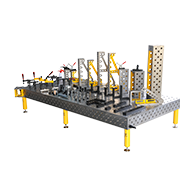
Multi-function 3D welding table
Modular clamp holding system
Modular clamp holding system
Hotline:400 004 8480
Full load-bearing chassis frames, welded on a flexible line
Rectangular-tube frames are the safest structure a bus can carry. Welding them flat — and changing model without rebuilding the tooling — is the hard part. This system does both, and it has been running in production since the first full load-bearing frame line in the industry.
Frame type
Full load-bearing, rectangular tube
Fixture system
3D flexible modular, re-settable per model
In service
CRRC Times Electric · Zhejiang CRRC
Scope
Chassis assembly to complete body line

The challenge
Two problems decide whether a bus frame line makes money: distortion that accumulates along the frame, and the model mix that changes under it.
Heat, length and thin members. A full load-bearing frame is a rectangular-tube lattice. It carries the bus, so the structure is safe by design — but every metre of weld puts heat into a long, thin member. Distortion accumulates station by station, and correcting it afterwards is hand work against a clock.
Custom, small batch, personalised. Bus production is the opposite of mass production. A dedicated jig for every model means new tooling, new floor space, and a line that stops for weeks each time the model mix moves.
The economics only work if the tooling re-sets. Special vehicles, engineering vehicles and coaches are built in small batches. Flexible fixturing is the method that makes that batch size affordable.
The system
The fixture set is built from standard modules — locating, supporting and clamping elements arranged on a rigid table. What changes between models is the layout, not the hardware.
1 set
Positioning pins, support blocks and clamps are placed on a hole-grid table. A new frame variant is a new layout on the same table, not a new fixture.
Flat held
Rigid support under the member and clamping in sequence hold the frame flat while the weld cools. The structure absorbs the heat input instead of the operators correcting it later.
Re-setper model
Changing model means repositioning the modules and re-checking against the drawing. No new jig is designed, built and installed between orders.
Proof in production
The system was proven on a full load-bearing frame before it was specified plant-wide.
First application
The first domestic manufacturer to run a full load-bearing chassis frame on a 3D flexible modular fixture system. The result set the reference for flexible frame welding in the new energy bus industry.
Plant-wide system
A complete 3D flexible welding fixture system, developed and built by Dongguan Sanwei, for the plant's welding production line — frame variants on one fixture pool.
Where it fits
Full load-bearing frames, model mix changing with every order.
Long frames, tight flatness, welded in low volume.
One-off and short-run frames where a dedicated jig never pays back.
Heavy members, small batches, frequent variant changes.
Any frame programme too small for tooling per model.
Existing stations re-fitted with flexible modules instead of new jigs.
What it changes
One fixture pool covers the frame family, including variants added later — instead of a jig per model.
Idle dedicated jigs no longer occupy the bay. The same tables serve the next order.
Model change is a re-layout and a drawing check, not a design-build-install cycle.
Tell us the frame envelope, how many models you build and the batch size. Our engineering team will come back with the fixture layout, the station count and the changeover method.
Talk to engineering · 400-004-8480Fixture system
3D flexible modular
Frame type
Full load-bearing, rectangular tube
Reference plants
CRRC Times Electric · Zhejiang CRRC
Manufacturer
Dongguan Sanwei
Flexible Automation Equipment Co., Ltd.

Follow us
 Mia Liu
 400 004 8480